How I Did It: Building A Photo Studio
My background is in Graphic Design and Illustration, so I never in my wildest dreams imagined I'd spend so much time at photo shoots. We're talking countless hours planning and art directing shoots, but I'm grateful for this path for a lot of reasons. It lets me escape the office, work on impactful projects, and collaborate with talented and diverse creatives.
So when I got the gig at Fetch Rewards to revamp their in-app photography and set up a custom photo studio, I jumped at the chance to make a mark!

So where does one even start? Here are the questions I asked myself along the way:
What Are We Shooting?
We initially focused on CPG, brand, and merchandise photography, requiring clear product images on plain backgrounds, environmental shots, brand hero images, and various Fetch merchandise like mugs, pens, sweatshirts, and hats. We also planned to expand to marketing campaigns, B2B and recipe videos, social content, and high-volume CPG.
Who Will Be Using The Studio?
Photographers, stylists, set builders, talent, producers, art directors, creative directors, studio managers, editors, videographers, etc. So a smart, usable space will be essential to nurture collaboration and efficiency.

What Challenges should be considered?
Key challenges include lack of wardrobe space, complicated organizational system, inadequate props, tripping hazards, inconvenient dressing room locations or makeshift dressing rooms, poor layout, hauling heavy items, insufficient counter space for food styling, limited storage, outside interruptions, inability to scale due to resource constraints, video and sound issues, unpredictable lighting, and the quickly escalating need for growth, speed and high-quality output.
Where Should The Studio Be?
We considered either finding an existing studio or creating one. Options included industrial spaces, offices, and warehouses, with location and proximity to the office being crucial to stay connected with the business.
We narrowed it down to two main choices: a small, old space across the street with character (street cred!), or a more expensive, customizable open space just one floor above the office with ideal northern light exposure and large nearby bathrooms. We chose the latter.

Who To Consult On Planning?
Studio planning at Fetch began with the creative director, office manager, and art director (me). We added a producer for budget advice, timelines, and industry expertise. We consulted a photographer from a similar studio and two others for equipment and management advice.

With a layout in mind, we hired a builder and architect on blueprints before construction. The builder ensured compliance and contracted plumbers, electricians, HVAC, and interior designers.
Building management and the owner were kept informed throughout the process.
We coordinated with the CMO and CTO on final decisions, budget, and timing.
After completion, we hired a full-time in-house photographer to work with the producer and me on equipping the space and adding storage and furniture.
What Are Our Space Must-Have's?
Based on our combined experience, and Fetch's specific needs, here is our customized must-have list:
Ample storage to accommodate growth.
Mobile furniture for flexible space customization.
2-3 bays with studio tables for multiple stylists.
Wardrobe and fitting rooms near the set.
Talent styling station with industry standard mirrors and lighting.
Fully-equipped kitchen for food styling and recipe testing.
Double doors for carting in and out larger sets and furniture.
Work stations for photographer/editor and videographer.
Abundant outlets and retractable power cords.
Blank walls for painting permanent sets.
Black-out curtains for light control.
Numerous prep tables, lab stools, standing tables, and drafting chairs.
Collaboration table with outlets, and storage for personal items, monitor for meetings.
Lounge areas for guests, talent, or crew.
We will eventually come to have all of this and more!
What Items And Equipment Is Needed?
Products: Brand partner items from companies like General Mills, Mars, Unilever, Kraft Heinz, Coca Cola, L'Oreal, etc. (slowly building our inventory)
Props: Dinnerware, cookware, barware, fake and real

food, office supplies, home decor, sports equipment, electronics, seasonal props, pet accessories, etc.
Backgrounds: Paper boards, printed vinyl rolls, grass, decking, stone, sand, wood boards.
Camera Equipment: Cameras, t-stands, tripods, lights, soft boxes, cords, batteries, storage, tape, tables, reflectors, cases, carts.
Kitchen: Utility sink, cabinets, countertops, industrial fridge and freezer, standard appliances, utensils.
Set Stylist Tools: Mobile cart with wet wipes, tapes, scissors, clips, cotton balls, pins, blocks, etc.
Wardrobe/Makeup: Racks, steamers, basic wardrobe, fully stocked makeup station, hair tools, accessories, privacy curtains, lighting.
Storage: Clear containers, bins, shelves, tables, labels.
Studio: Tables, waste management, pet needs (we are a pet friendly studio), utility carts, parking, ladders, storage, tools, craft supplies, seating, curtains, security, safety gear.
Merchandise: Display racks, inventory and archiving, sample receiving, storage.
How Can We Accomplish This On A Balanced Budget?
Investing in a photo studio is significant. Honest discussions with leadership early on ensured we stayed within budget, seeking approval for any necessary increases with detailed justifications and cost research. Practical decisions helped manage expenses: opting for DIY solutions when possible and contracting talent/crew only for special projects.
Determine what kind of studio you need by assessing your content creation frequency. If

occasional, renting an independent studio suffices. However, if you require high-volume, consistent, custom content, a dedicated studio may be ideal to enhance brand control and meet client demands.
Consider your specific needs, whether for video, social content or B2B, and plan your space and equipment accordingly. Keep future growth in mind.
Timeline Of Events

A concise overview of the planning steps from concept to grand opening and beyond.
2022
Oct: Initial studio budget approval, creative director hires me for planning, search for space begins.
Nov: Shadowed Marketing during seasonal photoshoots, started testing Fetch branded photo styles.
2023
January: Consulted with photographers on equipment and space usage.
February: Chose studio location, toured space, and began planning layouts with the builder. Approved photo styles and started collecting props.
March: Approved square footage and finalized blueprints.

April: Approved photo style and started renting studios to begin. Mentored our merchandise graphic designer to photo assistant (and eventually art director.)
May: Broke ground! Finalized photography processes. Demand continues to build, so we converted office conference room into mini studio for simpler shots.
July: Hired producer (phew!) for planning and photoshoots, created equipment lists.
Sept: Hired photo retoucher.
Dec: Studio completed, move-in begins, videographer sets up.

2024
January: Last photoshoot at rented studio and grand opening party.
Feb: First photoshoot in new studio, started to incorporate Marketing campaigns.
March: We are now under Marketing instead of Product, added social content and videos.
May: Promoted photo retoucher to in-house photographer.
June: Established weekly shoot schedule and scaled output. Now we're off to the races!
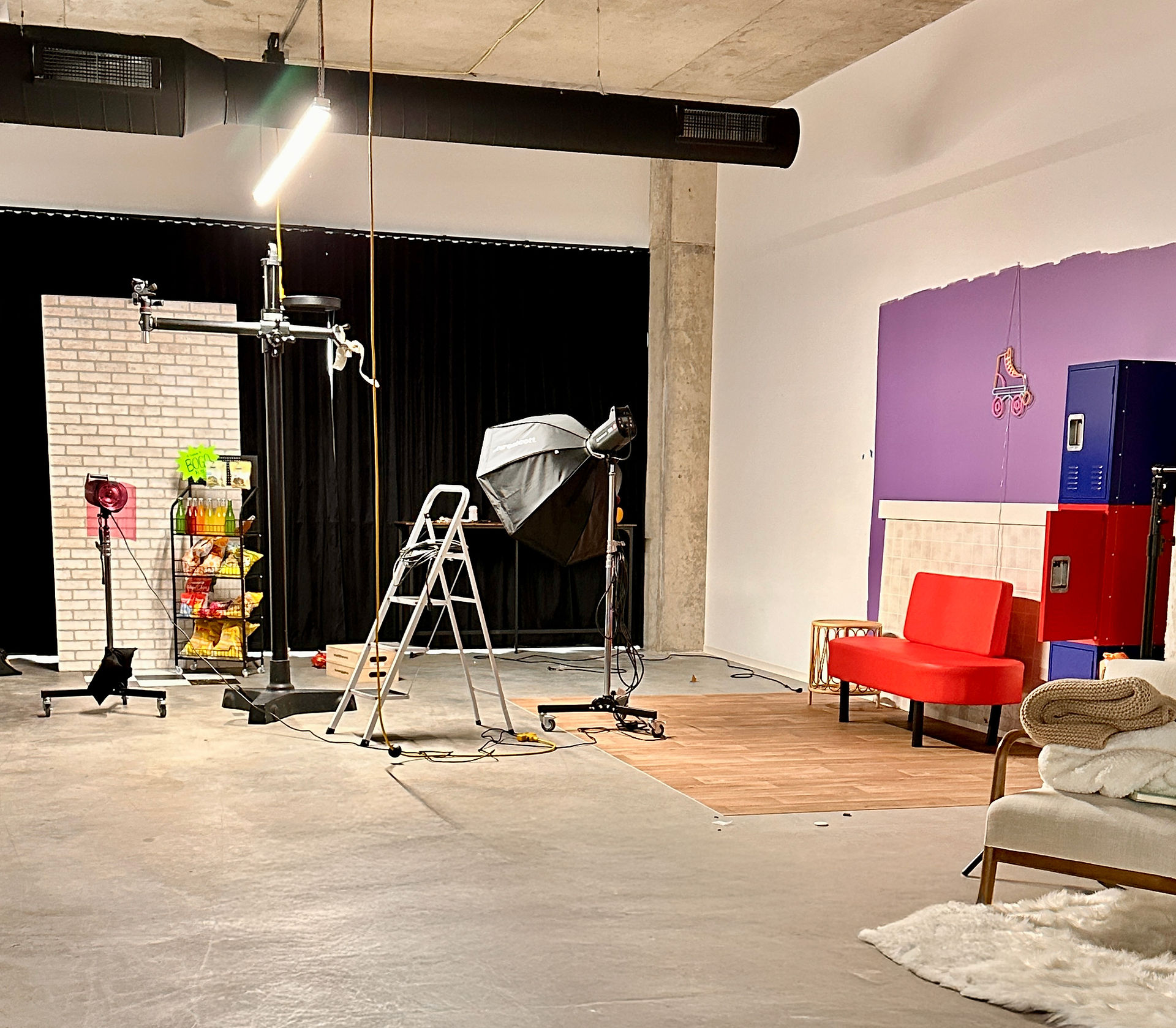
Click through gallery to see more of the studio during move-in:




Unexpected Challenges
Collaborating with a builder and interior designer on an industrial workspace was challenging due to their unfamiliarity with our specific needs. It required educating them and touring other studios. Outsiders tend to be surprised when seeing studios, which aren't glamorous and have safety protocols (avoid open-toed shoes and watch for light stands).

The space is constantly reconfigured, so everything is on
wheels, eliminating the need for carpeting. We require floor-to-ceiling storage, no drop ceiling, and paintable walls instead of artwork. Offices aren't necessary as we are on the go all day, and windows are kept shaded to control light.
Another challenge was sourcing partner products from our regional stores, which often delayed deadlines. We addressed this by utilizing our "Boots-On-The-Ground" team, who were already collecting receipt data, and by refining our intake process to better understand product availability.
Moving large items was tough. The studio is on the 3rd floor in a commercial/residential building. There's no docking bay or freight elevators, so we had to get creative when squeezing a 10 foot t-stand in the elevator. Or overloading our cart with delivery boxes and navigating it between tight doorways without banging our fingers.
Transitioning to a Scalable Multi-Channel System
Initially, we focused on CPG, brand heroes and merchandise, starting with 2 bays and ample storage. As we expanded to include marketing campaigns, social content, and video, we added another bay, enhanced the videographers' station, and optimized resources by combining photo and video shoots. We reorganized props for seasonal campaigns and updated processes to handle a wider range of projects.

Our growth relied on smart early planning for efficiency. We chose a compact but tall space to keep sets close to the prop room and styling areas and built shelving to the ceiling for storage. Ample tables allowed props to remain available throughout campaign seasons. A well-equipped kitchen enabled same-day recipe testing and improved food styling, reducing the need for weekly specialists.
We strategically selected talent: a producer experienced in photo AND video, a retoucher with photography skills who could grow with us, and a graphic designer who was trained in producing and art directing when her workload was light.
Successes and Learnings
Our success was driven by an insightful creative director, supportive leadership, clients who valued our unique services, and a tech company that provided necessary resources to align with our Speed, Quality and Growth (SQG) philosophies.

We expanded from a small makeshift conference room studio and renting spaces for just that one monthly photo shoot capturing only 50 photos... to three shoots weekly, capturing sometimes up to 300 images! Improved workflows and communication reduced turnaround times from 1-2 months... to on average of 5-7 days or less.
We learned the importance of flexibility, forming a multidisciplinary team, fostering creative experimentation, and collaborating across departments. This symbiotic environment naturally enhances SQG.
Conclusion
Building an in-house studio (or anything really) requires smart planning by experienced individuals to minimize challenges and inefficiencies.
Expect the process to take about a year from inception to opening.
Initial substantial funding and creativity to manage budget constraints are needed, but overhead costs are minimal once invested.
Utilize local talent and experts: photographers for equipment, producers for planning, stylists for props, builders for regulations, project managers for business needs, leaders for growth, and creative directors for vision.
An in-house solution may not suit everyone, but it can elevate your brand, enhance control, ensure quality and consistency, and save money long-term.
The Studio team goes even further than just photo and video, employing a full-time illustrator, production artists, and animators. Check out our sizzle reel!
A note on AI: AI is rapidly transforming our industry, yet it still falls short in consistency, quality to replace humans. I'm skeptical it ever will, due to AI's lack of original thought and its limitations in executing a project from start to finish without relying on numerous platforms (that AI bubble will be painful when it bursts). However, it serves as an excellent TOOL!
For instance, when I wanted to showcase a beautiful foam art latte in a mug during a shoot, but my barista skills weren't up to par. Hiring a professional wasn't within budget, and I didn't have time to learn. AI to the coffee rescue! Or when I needed to quickly assemble a mood board for a client but couldn't find the right inspiration on Pinterest because my idea simply. Didn't. Exist. Yet. AI to the mock-up rescue!
There are countless other applications for AI, and creatives are clever enough to find innovative ways to integrate it into their workflow. What impresses me most is its ability to summarize legal documents for clarity or to refine my disorganized, rambling typing. But when it comes to ideas and execution, humans surpass machines every time.


Comments